Apsara's Log: In the West Indies
|
| February 27, 2004 |
Lat: 14 N Long: 61 W |
Island: St Lucia, West Indies |
| Air Temp: 82° F |
Water Temp: 82° F |
Price of Mt Gay Rum: $6 btle |
|
As our good yacht broker, Paul Kaplan of KKMI,
put it, we hit a rum front when we completed the 3000 mile transatlantic crossing and for the past
month(s) the log has been sorely neglected in lieu of relaxing, visits from friends, and work (!).
Apsara and her crew of eight crossed the finish line in Rodney Bay, St Lucia on December 9, 2003, 15
days 23 hours after we last touched land in the Canary Islands.
We were one of the earlier arrivals to St Lucia, and for the next week and a half the remaining
nearly 200 boats arrived as we shared sea stories and Piton beer with friends made before, during
and after the crossing. The crew cleaned the boat, packed and headed home to the UK, Sweden,
France, New Mexico, Texas, and California. Nancy and I sailed a short but bouncy 20 miles north to
St Anne's, Martinique where we finally we able to drop anchor and begin the daily routine of
swimming, eating, buying mangoes and trying to fix our fancy French autopilot, which faithful
readers will recall broke on the second day of the transatlantic passage. We also celebrated both
of our late-December birthdays. I got a special treat from nature on my birthday - as we watched
the sun set over the water - I finally saw the famous Green Flash.
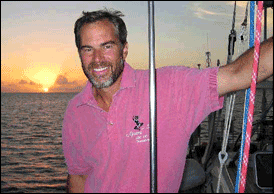 |
With no real gifts for Nancy on her birthday, she was offered
the choice of spending the day with a
handsomely-bearded old salt or a clean-shaven husband. Strangely, she ecstatically chose the smooth
"fresh" face and I spent the next several hours shaving on the swim platform with dull razor.
|
A very quiet Christmas was spent anchored
in 30 feet of clear blue water in Grand Anse, Martinique
snorkeling and having drinks with the only other under 60s, English-speaking boat in the bay, a
young couple from London on a boat called "Street Car" - not a bad name considering that Rory
and Kate were/are transportation consultants.
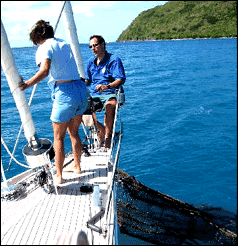
Ted and Selina Huber endured a harrowing day of inter-island travel on an overcrowded local ferry
from St. Lucia to Martinique and joined us on the evening of 26th burdened with gifts for us. (We
love when they visit 'cause we get all their old New Yorkers). They patiently spent the 27th
with us and our French mechanic as we continued to try to get the Fancy French autopilot fixed.
We were now, gratefully, in a part of the world filled with beautiful anchorages and we were
looking forward to spending our nights at anchor. However, we were off to a poor start when on two
consecutive evenings we hooked abandoned fish traps left on the bottom. Nancy was grateful to have
Ted aboard to help her fiddle with boat hooks for 20 minutes to get us free. To add insult, both
the traps were empty.
 |
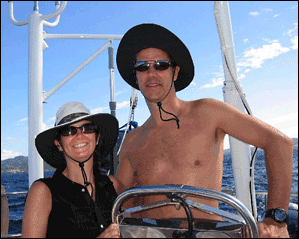 |
| Anchor follies - Fish trap snagged |
Selina and Ted with big hats |
On the 31st we sailed north in
moderately strong winds to St. Pierre and went ashore to sort out a
taxi to get Ted and Selina to the airport the next morning. Guess what? Due to a combination of
French work rules and the local importance attached to getting really wasted on New Years Eve, no
one in town would take them to the airport for less than $200. After three hours of wangling and
bus trips to the next town an enterprising driver was found. In spite of a short trip somewhat
plagued with transport problems, it was really nice to have good friends aboard and Ted and I
managed to find an evening to put a dent in the single malt and catch up on life. Selina was five
months pregnant and as pretty, charming, and non-seasick as anyone could be.
After too short a visit the Hubers left us on New Years Day and we prepared to sail Apsara north 140
miles to Antigua via Dominica, and Guadeloupe. In normal weather this would have been three
delightful day sails with the wind on the beam and medium seas. However, a high pressure system
north of us had the winds blowing a force 7 from the NNE - basically the direction we wished
to go.
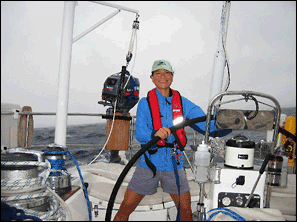
| We bashed our way north under staysail and triple reefed main into 27 -
33 knots of wind and
15 to 20 foot seas (and horizontal rain at times). But Apsara was in her element and while
the decks were frequently awash and the gusts hit 35 knots, she sailed along like it was a summer day on a pond while her
faithful crew was drenched, but smiling. |
 |
Upon arriving in Antigua on January 6th we fell into
the black hole of boat repair work where
immense forces conspire to suck money and life out of naïve yachties. We were unable to break
fully free of these forces until mid-February. The repair list was not unusually long, just
difficult to get completed in a timely fashion. Heading the list was getting the refrigeration
system working in top form, stopping the ongoing rudder leak, adding new bottom paint, and repairing
boom and vang attachment points damaged crossing the Atlantic. On top of this we wanted a few new
things. Most important was a second, fully redundant, (English/American) autopilot for the next
time the Fancy French Autopilot fails. Also on the list was an upgraded alarm system since we
expected to be spending a lot of time in areas (mostly Venezuela, Panama, and some of the British
West Indies) that have a sketchy reputation for security. We expected that Antigua would be the
last, best place to get significant repairs done before we reach New Zealand and we wanted
everything to be in the best condition possible.
Fortunately, Antigua was a generally great experience with all of our work coordinated by Stan
Pearson of Antigua Rigging who serves as Nautor Swan primary service center in the Caribbean.
Falmouth and English Harbors seem to be exceptional places in the British West Indies. Without
exception we found the relationship between the locals and visitors to be warm, helpful, and very
low on attitude. At the "Cat Club Marina", where we were based, we became friends with many of the
local business owners. I was invited to sail in a regatta on the boat of the yard's owner Hugh
Bailey. We were invited to local BBQs. Everyone's friendly attitude made the time as enjoyable as
working on your boat rather than sailing it in tropical paradise can be.
Antigua is the superyacht center of the Caribbean and some of the largest and most beautiful
sailboats in the world moor there for months while the crews wait for the owners to helicopter in
for a few weeks. One crew estimated that the owner would spend only eleven days on the yacht during
the whole five month season here. We met up with several of our old Swan crew friends that we first
met in Finland or elsewhere in Europe: Jon and Tracy on Cigno Rosso, Selwin and Branwin of
Kalavala, and Nigel & Tamson of Steadfast all Swan 60s were great company and it was wicked fun
to hear their stories about a professional sailing life tending to guests and owners.
The only person with less patience than me for whiling away our vacation in a boatyard is Nancy, who
we both agreed should take a quick trip north to visit some friends. While she was gone I decided
to surprise her by meeting her plane on its way back to San Juan. With some difficulty O booked a
flight for a Saturday afternoon arrival in San Juan and a Sunday return to Antigua that matched
Nancy's. I failed to get a hotel reservation and figured, "how tough could that be?" Of course, I
arrived in San Juan to find that the biggest festival of the year was happening that weekend with
people flying in from around the world, AND Saturday night is the toughest night for a room in San
Juan because all two dozen-plus cruise ships change passengers over Saturday night. The woman at
the tourist bureau searched for an hour and found nothing, at any price, within 75 miles of the
capital. Finally, as the office was about to close and I was envisioning which beach I might
sleep/get robbed on, she found me a place at "a hotel for people who's family members are in the
hospital". Ok, any bed will do. I was a bit taken a back when the taxi pulled up to the
Cardiovascular Hospital of San Juan and I learned that my room was on the fourth floor in a
converted hospital room - complete with handicapped bathroom, a door big enough to roll a
gurney through and a crabby nurse doubling as cashier/concierge/maid! The turndown service was
abysmal.
We escaped Antigua on February 8th with two guests: Marshall Haines and his friend Paula. Marshall
is a friend from my days in Boston with Bain Capital. Marshall is switching jobs, wisely negotiated
several months off, and is not letting any grass grow under his feet. He had already been
windsurfing in Venezuela, rafting in Chile, and was going skiing in the Alps after our trip. Paula
had decided to join Marshall on the spur of the moment and told her boss via e-mail that "something
had come up with a friend and she was needed" and then left 48 hours later, never having been able
to speak directly with him. She was a ball of fun and we were happy to have them both aboard, but
the trip did cost Paula her job, which she, in typical Paula-fashion, seemed fine with.
 |
 |
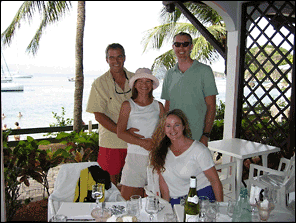
Lunch at Iles Des Saintes
with Marshall and Paula |
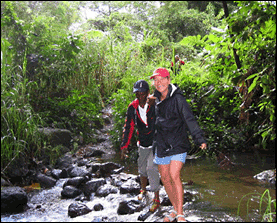
Guide Vincent helps Nanc
across a river in
Dominica |
We spent a few nights in Deshaies, Northern Guadeloupe where Paula
and Marshall scuba-ed. Paula is
not certified/trained in diving, but goes anyway and considering herself something of a mermaid,
does just fine. We pushed on for Le Saintes, which are very charming little islands south of
Guadeloupe populated by descendents of Normandy and Brittany from the 1600's; the average local is
blond & blue-eyed. We ate good food here, smoked Cubans, played charades, and rented
power-assisted bikes to tour the island which has very steep hills with magnificent views. Paula,
who had never sailed a hobie cat and hadn't done much other boat sailing, rented a hoby cat with two
French guys who couldn't sail and spent an afternoon terrorizing them as she figured out how to make
the boat go, which she did just fine.
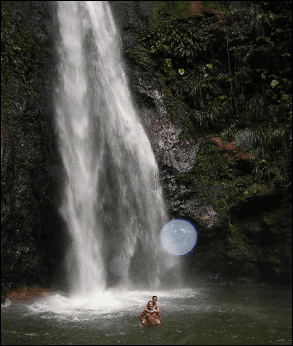 |
| 80 foot Milton Falls - Dominica |
|
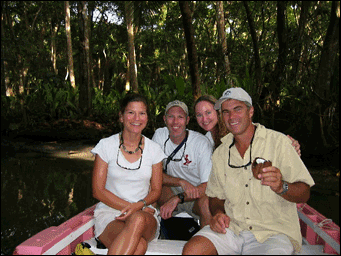 |
On the Indian River
with Marshall and Paula
Dominica |
|
We sailed another 30 miles south to what
turned out to be one of the favorites of our Caribbean
experience thus far, Dominica. Dominica is probably the least developed, most rugged island in the
whole chain. It has seven currently quiet volcanoes and a deep, rich, wet rain forest interior
where they grow nutmeg, bananas, grapefruit, avocados, oranges, coffee, mangos, papayas, etc, etc.
We anchored in Prince Rupert Sound off the northern town of Portsmouth in clear blue water over
white sand for two days. We explored the interior and did more diving, this time I joined and was
reminded how beautiful scuba can be. Paula successfully completed her sixth un-certified dive. A
long-time farmer and now guide took us into the mountains and on a hike to a huge waterfall. Along
the way, in light warm rain, he stopped and cut fresh fruit from abandoned orchards explaining that
"grapefruit harvested in the rain turns black in two days", "wood cut within two days of a full moon
will be stronger than wood cut during a quarter moon", "that plant is good for coughs" and other
folk wisdom. We returned to the boat with a dozen beautiful grapefruits (all of which were covered
in black spots three days later), oranges, cinnamon bark, nutmeg, and other delights.
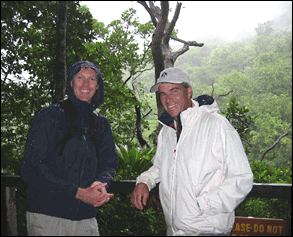 |
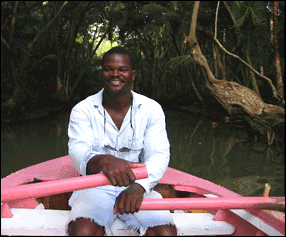 |
| In the rainforest of Dominica |
Martin, our Indian River Guide |
We moved south on the island to the Anchorage Hotel
where we read one can pick up a mooring and tie
stern to a palm tree on the shore - romantic sounding. But there were no moorings -
apparently several had failed recently due to poor maintenance, so we dropped the anchored and
backed her up to the shore where a "boat boy" named Poncho took our 200 foot stern line to his palm
tree. The final surprise of Dominica, is that it is one of the best places in the world to see
sperm whales. The local dive/whale watch shop runs boats that, under the right conditions will
allow you to get into the water and actually swim with the whales and they had the pictures to prove
it. We had planned to sail to Martinique in short order, but one does not wisely pass up a chance
to see sperm whales (up to 55 feet they grow, 33% of the animal is head!, and they dive 2000+ feet
to eat giant squid, which incidentally have never been seen alive by humans). So off we went, I
fully prepared to spend the afternoon motoring in the hot sun for hours and seeing nothing. But
within 20 minutes the telltale blow of a whale was sighted and we turned toward him/her. Before we
could close the distance, we saw tail flukes as the whale dove. As it turns out this is the way the
game is played and the operator put a hydrophone into the water and we listened to the clicks of the
whales. After a predictable 30 to 45 minute wait, the whales surfaced a few miles to the north and
we were able to slowly edge close enough to see a nursing mother and calf and hear the sound of them
breathing. The guides were genuinely concerned about the whales and kept a safe distance directly
behind the whales where we were less likely to be detected since sperm whale sonar works forward and
laterally. It was a beautiful sight and we followed this family for several more dives and surfaces
but were told that we could not go into the water since the calf was nursing. The next day Marshall
magnanimously hired the whole boat and we went out again for one more try to swim. This time we got
lucky and were able to be in the water very briefly and see a juvenile whale from about 15 feet away
that was slowly swimming toward us. Once we were in the water the whale changed his mind and swam
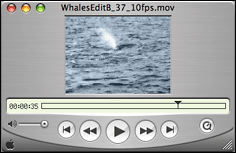
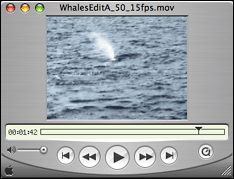
away but for a moment, Wow! Very cool and something to remember. Check out Marshall's video clip
of the whales here:
After ten days, Marshall
and Paula left us in Dominica and we stayed one more night with our stern
tied to Poncho's palm tree, enjoying the gentle swell before sailing in the morning for St. Pierre,
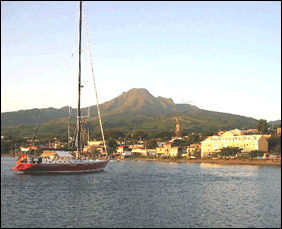
Martinique. St Pierre was a wonderful anchorage - much better than our last stop here when
the weather was rough. We stayed four nights waking each morning at the foot of the lush, green,
towering volcano reflecting in the flat calm water, swimming and going ashore to buy fresh fruits,
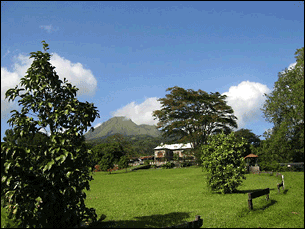
vegetables and fresh mahi mahi or tuna. We visited a couple of working rum distilleries which were
both interesting and beautiful. One, Habitation Clement, was the site of a French-American summit
after the first Gulf war. There were no signs of preparation for a second summit.
 |
 |
Swan 68 "Joy" and the Volcano
at St. Pierre |
Depaz sugar plantation
and rum distillery |
In St. Pierre, we finally got the Fancy French Autopilot working
again - small victories.
And, today we are back, after two months and 350 miles of sailing, in Rodney Bay, St. Lucia trying
to get the Fancy new English Autopilot working properly! We have had glorious sailing days in the
past week as Apsara moved along at 8 to 9 knots through flat water in 12-15 knots of breeze with
Nancy and I reading, fishing, and taking in the wonderful ever-changing light and colors of the
tropics. Life is great even with only one autopilot.
~~~~~~~~~~ ~~~~~ ~~~~~~~~~
Next stops will be south through the rest of the Windward
Islands and then on to Venezuela and
Panama where we will spend a several weeks in the remote San Blas Islands before transiting the
Panama Canal sometime near the end of April. We are looking forward to meeting up with Nancy's
parents from Bonaire to Aruba, and my Dad and Kathi from Aruba to the canal.
_________________
s/v Apsara
www.svapsara.com
|